Chief Minister Vishnu Deo Sai stated that, for the first time since the state’s formation, he attended the International Trade Fair accompanied by such a large number of his cabinet colleagues.
Colors of Chhattisgarhi folk culture adorned Bharat Mandapam, with traditional dances captivating the audience.
Chhattisgarh State Day celebrated with great fervor with Governor Ramen Deka and Chief Minister Vishnu Deo Sai presiding over function
New Delhi, November 20, 2026 – It was an evening filled with Chhattisgarh’s rich art and culture at the 45th India International Trade Fair (IITF) in Bharat Mandapam, where artists from Chhattisgarh mesmerized hundreds of spectators with their performances at the amphitheatre on the occasion of the Chhattisgarh Day celebration.
During the grand cultural event organized for Chhattisgarh State Day, local folk artists enthralled the audience with captivating performances of traditional dances and folk music. Chhattisgarh Governor Ramen Deka was the chief guest and Chief Minister Vishnu Deo Sai presided over the function. The event offered a mesmerizing glimpse into Chhattisgarh’s distinct cultural identity, rich tribal traditions, and vibrant folk arts in the national capital.
Addressing the event, Governor Shri Ramen Deka stated that Chhattisgarh is a state with immense potential for development, characterized by its abundant natural resources, agriculture, industry, and a rich cultural heritage. The state offers vast investment opportunities in sectors such as steel, cement, energy, aluminium, food processing, and manufacturing. Through the new Industrial Development Policy 2024-30, the state is actively promoting investment, job creation, and entrepreneurship. The Governor urged industrialists and investors—both from within the country and abroad—to capitalize on the opportunities in Chhattisgarh and become partners in the state’s progress. Emphasizing the importance of agro-based industries, as well as the processing and value addition of minor forest produce, he noted that development in these areas would boost the income of local residents and strengthen the rural economy.
Governor Shri Deka remarked that the true strength of Chhattisgarh lies in its hardworking farmers, talented youth, women, and skilled artisans. He stressed the need to engage the youth in startups, innovation, and entrepreneurship, while also providing access to national and international markets for products created by women’s self-help groups and local craftspeople. He highlighted that the state’s rich tribal culture, handicrafts, handlooms, and tourism destinations hold great potential for economic growth and employment generation. He added that preserving cultural heritage is just as vital as pursuing development. Through collective effort and public participation, Chhattisgarh can be transformed into a state that is economically prosperous, industrially robust, culturally glorious, and socially harmonious.
Speaking at the event, Chief Minister Shri Vishnu Deo Sai observed that the identity of Chhattisgarh is undergoing a transformation. Regions like Bastar—once discussed primarily in the context of Naxalism and various challenges—are now emerging with a new identity, defined by their rich tribal heritage, vibrant folk culture, natural beauty, and promising new avenues for development. The representation of Chhattisgarh at the India International Trade Fair, held at Bharat Mandapam, serves as a testament to this evolving era. Here, one can witness a unique confluence of tradition and modernity, heritage and development, as well as local craftsmanship and economic potential.
On this occasion, Chief Minister Shri Vishnu Deo Sai stated that this is the first time since the formation of the state that he has attended an international trade fair accompanied by such a large number of his cabinet colleagues. He remarked that the fair offers a unique glimpse into Chhattisgarh’s rich folk culture, tribal heritage, and development—showcasing the state’s evolving landscape and its new identity to the nation and the world.
He noted that Chhattisgarh is distinguished by its natural beauty, rich cultural diversity, and unique folk traditions. The state’s folk culture is an invaluable heritage, preserved through generations by folk artists. Traditional folk dances and performances—such as Gaur, Gaura-Gauri, Bhojali, Raut Nacha, Sua, Panthi, and Karma—serve as symbols of Chhattisgarh’s cultural richness. Events like this provide an important platform to introduce people from across the country and abroad to the art, culture, and traditions of Chhattisgarh.
The Chhattisgarh State Day celebrations were attended by several notable figures, including Union Minister of State Shri Tokhan Sahu; Deputy Chief Ministers Shri Arun Sao and Shri Vijay Sharma; Minister of Tourism and Culture Shri Rajesh Agrawal; Minister of Skill Development and Technical Education Shri Guru Khushwant Saheb; Minister of Public Health and Family Welfare Shri Shyam Bihari Jaiswal; Rajya Sabha MP Shri Devendra Pratap Singh; former MP Pradeep Gandhi; Chairman of the Chhattisgarh State Industrial Development Corporation (CSIDC) Shri Rajiv Agrawal; Chairman of the Chhattisgarh Khadi and Village Industries Board Shri Rakesh Pandey; and Chairman of the Waqf Board Dr. Salim Raj.
The highlight of the Chhattisgarh State Day celebrations, held at the amphitheater of Bharat Mandapam, was the captivating cultural performances by the state’s folk artists. Adorned in traditional attire and ornaments, the artists brought Chhattisgarh’s folk culture to life through their dance movements, melodious folk music, and rhythmic performances. The energetic displays, accompanied by the resonant sounds of the mandar, dhol, and other traditional musical instruments, infused the entire atmosphere with a festive spirit.
The cultural program offered a glimpse into the tribal traditions of Bastar through the Gaur dance, while the Gaura-Gauri dance introduced the audience to the state’s folk beliefs and customs. The Bhojali dance reflected Chhattisgarh’s agrarian culture and the deep-rooted reverence for nature. The Raut Nacha, characterized by its traditional costumes and distinctive dance style, presented the state’s folk heritage in a compelling manner.
The rhythmic Sua dance showcased the folk traditions and collective cultural life of the women of Chhattisgarh. The Panthi dance highlighted the spiritual and cultural heritage of the Satnami community, while the enchanting Karma dance brought to life the spirit of nature and communal celebration. Together, these folk dance styles from various regions showcased the rich cultural diversity of Chhattisgarh on a single platform.
The artists’ vibrant traditional attire, ornaments, folk instruments, and synchronized dance movements became the center of attraction for the audience. Each performance unveiled a new facet of Chhattisgarh’s folk traditions. The cultural program provided the audience with an insight into the state’s rural life, tribal culture, folk beliefs, and festive customs. Held in the national capital, this cultural evening not only provided a prominent stage for the folk arts of Chhattisgarh but also effectively showcased the state’s unique cultural identity.
Present on this occasion were Smt. Ritu Sain, Investment Commissioner for Chhattisgarh in New Delhi, and Dr. S., Secretary of the Department of Culture. Senior officials from various departments were present, including Rajesh Singh Rana, Secretary of the Village Industries Department; Rahul Bhagat, Secretary to the Chief Minister; Vishvesh Kumar, Managing Director of CSIDC; Shruti Singh, Resident Commissioner of Chhattisgarh; and Pankaj Kumar Agrawal, Deputy Director of the Khadi and Village Industries Board.
Chief Minister Visits the Pavilion
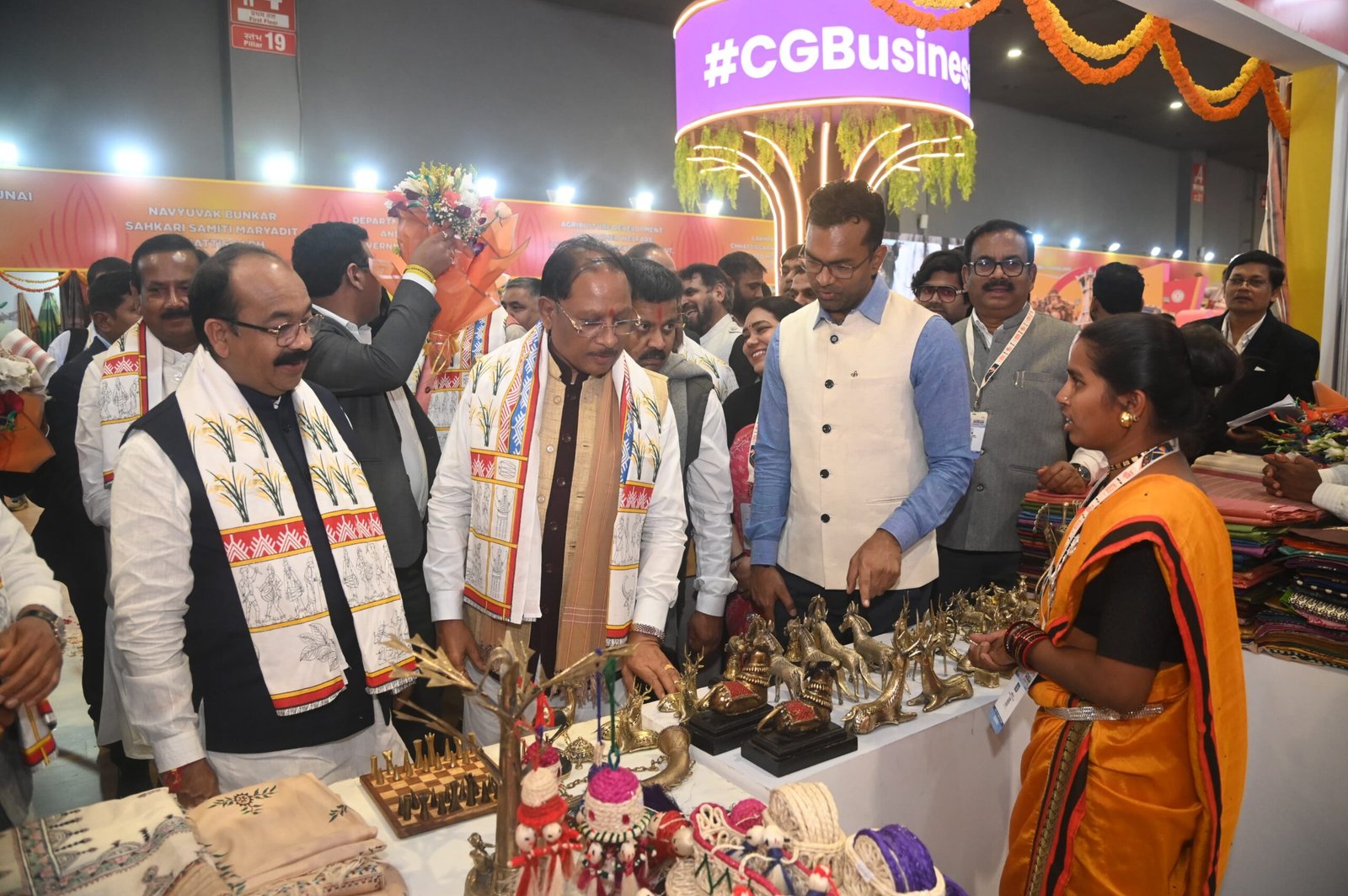
Chief Minister Vishnu Deo Sai visited the Chhattisgarh pavilion at the International Trade Fair. During his visit, he inspected the stalls set up by various departments and entrepreneurs, learning about the products, handicrafts, and local specialties on display. The Chief Minister examined traditional Bastar bell-metal art, Kosa silk from Champa, tribal jewelry, handloom textiles, and products derived from forest produce. He also inquired about millet-based products such as Kodo, Kutki, and Ragi, and commended the showcasing of Chhattisgarh’s rich artistic heritage and local products on a national and international platform.
Chief Minister Sai particularly appreciated the 3D virtual reality experience of the Chitrakote Waterfall featured in the pavilion. Through this technology, visitors are offered a virtual experience of the natural beauty of Bastar’s renowned Chitrakote Waterfall. The Chief Minister remarked that using modern technology to showcase the state’s key tourist destinations is an innovative effort to promote tourism. This initiative allows visitors from across the country and abroad to become acquainted with the natural beauty and tourism potential of Chhattisgarh.